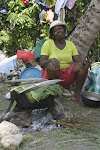
We left Port-au-Prince to visit the countryside, more precisely the Plateau-Central, the poorest region of Haiti.  The road that led us there was indicative of the state of the country, as it resembled a mountain riverbed as opposed to a smooth paved highway, much like the life of your average Hatian.  En route we passed Peligre Dam designed and built in 1950 to provide electricity to factories in Port-au-Prince, but not for the people of the region. Currently it only provides on average 3 hours of electricity per day, and only to those who can afford it.

As we progressed along the so-called road, we witnessed acute poverty in the form of shanty homes built of scrap wood/metal, roaming goats and chickens, sparse vehicles loaded with mangoes, bananas, and people in the room that was left, many of whom were scantily dressed.  Most of the people we witnessed along the road were simply waiting in front of their homes.  Others were involved in the mango harvest using boney horses and donkeys to transport the produce.

We arrived in Hinche, the capital of the Plateau-Central, where we met with regional coordinators of the CTH, none of whom are paid for their union work.  They explained the conditions within each sector they represented:  Commerce, cooperatives, journalism, construction, youth work, transportation, women's issues, agricultural workers, professional artisans etc.  And then each sector went into great detail as to what their problems were. The overwhleming obstacle was a complete and utter lack of infrastructure, such as means of transportation for their products, financial assistance to propel growth, irrigation, modern tools, local places to meet, schools, drinkable water, electricity, hospitals, social security or services, job training, child care, etc..

For the 55,000 people on the plateau, one of the only recourses is to work in the sugar can fields of the Dominican Republic for starvation wages, under conditions of extreme discrimination.  The only other recourse is to go to Port-au-Prince and attempt to join the informal economy. For many women this means prostitution, and for many men this means unemployment, begging or petty crime.
Sunday, April 27, 2008
April 25, 2008 (Second Day)

April 24, 2008 (Our First Day)
We were hosted by Paul "Loulou" Chery, the general secretary of the CTH. We visited the main building of the CTH, INAFOS (the National Institute for Social Training) where they used to train members in foreign languages (Spanish, English and French) as well as cadres that would go to the countryside to help organize for the union. The union has been suffering a low period over the last 5-6 years and the builiding has fallen into disrepair due to a lack of resources. They are in need of $25-30,000 for renovations and also need a steady income of $4-5,000 a month for operational costs. For the moment some of the space is being rented to other organizaions who need limited space.
Some Background
The IWW was invited by the CTH (Confederation des travailleurs haitiens, Confederation of Haitian Workers) in the hopes that we would learn exactly what work they have been doing in Haiti since 1959 and the difficulties they have encountered under the Duvalier dictatorships and the recent tyranny of neoliberalism.  Ultimately the CTH hopes the IWW will be able to help in material aid and help in forming links of solidarity with other anti-privatisation organizations.

History and Evolution of the CTH's perspective.

In 1959 the CTH was founded by Christian workers who were working in sweatshops during the dictatorship of Duvalier.  Many of these members were tortured, killed and forced into exile for their union activity.  But a small cadre remaining in Haiti went underground.  They focused on two objectives: organizing a country-wide union, and resisting the dictatorship of Duvalier.  However with the first democratic elections in 1990 the CTH emerged as a union active in advancing the interests of workers: good jobs, improvement of living conditions, quality of life, and grassroots changes of the country.  Since the overthrow of Aristide in 1991, the CTH has had its ups and downs, from strong influence with workers to a crisis that has challenged its very existence.  Following the coup d'etat of 2004 the CTH has been struggling to rebuild.  Paradoxically it has been reinvigorated over the past two weeks during the food crisis that has caused average Hatians to take to the streets and protest militantly against the the privatization policies which led to the tripling or quadrupling of the cost of living.  In this context the CTH is demanding a constitutional role for unions and union members.   The current president Rene Preval seems receptive to this idea.

Haiti has officially 8.5 million inhabitants, but in reality closer to 10 million (with another 4 million living abroad mainly in the US and Canada).  While it has an active workforce of 7 million there are 200,000 formal jobs of which 50,000 are in the public sector and 150,000 in the private sector.  However the government is in the process of cutting public sector jobs with great strides as is the private sector.
Tuesday, April 22, 2008
The IWW Mission to Haiti
The International Solidarity Commission of the Industrial Workers of the World is sending a delegation of five workers to Haiti to meet with labor groups and observe conditions in the country. We'll be there from April 23 to May 5, 2008. This blog will record the delegation's experiences and impressions.
Subscribe to:
Posts (Atom)